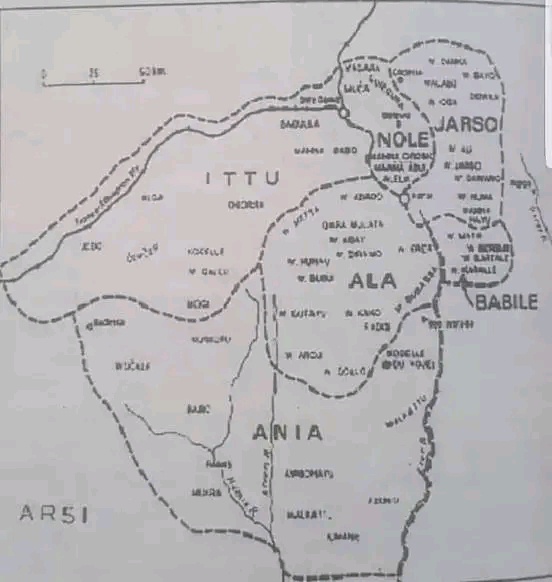
𝐓𝐡𝐞 𝐎𝐫𝐨𝐦𝐨 𝐨𝐟 Ittu, Afran Qallo and Anniya: 𝐎𝐧 𝐭𝐡𝐞𝐢𝐫 𝐒𝐞𝐭𝐭𝐥𝐞𝐦𝐞𝐧𝐭 𝐏𝐚𝐭𝐭𝐞𝐫𝐧 and 𝐭𝐡𝐞𝐢𝐫 𝐃𝐢𝐚𝐥𝐞𝐜𝐭:- The Oromo of Ittu, Afran Qallo and Anniya belong to the 𝐁𝐚𝐫𝐞𝐧𝐭𝐮𝐦𝐚/𝐁𝐚𝐫𝐞𝐧𝐭𝐨 confederation, one of the two main moieties of the 𝐎𝐫𝐨𝐦𝐨 𝐩𝐞𝐨𝐩𝐥𝐞. They are bounded by the 𝐀𝐫𝐬𝐢 𝐎𝐫𝐨𝐦𝐨 in the west and south, the 𝐊𝐚𝐫𝐚𝐲𝐲𝐮 and 𝐉𝐢𝐥𝐥𝐞 𝐎𝐫𝐨𝐦𝐨 in the 𝐧𝐨𝐫𝐭𝐡 west, the 𝐀𝐟𝐚𝐫 people in the north and the 𝐒𝐨𝐦𝐚𝐥𝐢 𝐩𝐞𝐨𝐩𝐥𝐞 in the 𝐞𝐚𝐬𝐭 and 𝐬𝐨𝐮𝐭𝐡 𝐞𝐚𝐬𝐭. They call their 𝐧𝐚𝐭𝐮𝐫𝐚𝐥 𝐡𝐨𝐦𝐞𝐥𝐚𝐧𝐝 “𝐅𝐮𝐠𝐮𝐠”. They are basically 𝐫𝐞𝐠𝐫𝐨𝐮𝐩𝐞𝐝 to 𝐭𝐡𝐫𝐞𝐞 𝐦𝐚𝐣𝐨𝐫 𝐭𝐫𝐢𝐛𝐞𝐬; the 𝐈𝐭𝐭𝐮, 𝐀𝐟𝐫𝐚𝐧 𝐐𝐚𝐥𝐥𝐨 and 𝐀𝐧𝐧𝐢𝐲𝐚.1).The 𝐈𝐭𝐭𝐮 𝐎𝐫𝐨𝐦𝐨 ocuppy the western part of 𝐇𝐚𝐫𝐞𝐫𝐠𝐡𝐞 𝐡𝐢𝐠𝐡𝐥𝐚𝐧𝐝𝐬. Their home area is called “𝐂𝐚𝐫𝐜𝐚𝐫” or “𝐎𝐧𝐚 𝐈𝐭𝐮𝐮”. They are the people who are very close to the assembly of “𝐂𝐚𝐟𝐟𝐞𝐞 𝐎𝐝𝐚𝐚 𝐁𝐮𝐥𝐭𝐮𝐦” under which the tradition of the Barentuma Oromo adminstration system is kept.The natural boundary between Ittu and Afran Qallo is 𝐁𝐮𝐫𝐪𝐚 𝐫𝐢𝐯𝐞𝐫 which is found near 𝐁𝐚𝐫𝐨𝐨𝐝𝐚𝐚 𝐭𝐨𝐰𝐧. The boundary between Ittu and Anniya is the 𝐑𝐚𝐦𝐢𝐬 𝐫𝐢𝐯𝐞𝐫.2).The 𝐀𝐟𝐫𝐚𝐧 𝐐𝐚𝐥𝐥𝐨𝐨 Oromo lay to the east of 𝐈𝐭𝐭𝐮 and 𝐍𝐨𝐫𝐭𝐡 of 𝐀𝐧𝐢𝐲𝐲𝐚𝐚. They are largest of the three groups both in thier population and the area they occupy. They have four main divisionscalled 𝐎𝐛𝐨𝐫𝐫𝐚𝐚, 𝐁𝐚𝐛𝐢𝐥𝐞, 𝐃𝐚𝐠𝐚 (which issubdivided to 𝐍𝐨𝐥𝐞, 𝐉𝐚𝐫𝐬𝐨 and 𝐇𝐮𝐦𝐞) and 𝐀𝐥𝐚. It is not clear whether the land of Afran Qalloo has a unique name although some people call it“𝐆𝐨𝐫𝐨 𝐅𝐮𝐠𝐮𝐠”. Afran Qallo had a long tradition of “𝐑𝐚𝐚𝐛𝐚𝐚 𝐃𝐨𝐨𝐫𝐢𝐢” assembly which was held at a place called “𝐁𝐮𝐥𝐮𝐥𝐨𝐨” near the town of 𝐖𝐚𝐭𝐚𝐫.3).The 𝐀𝐧𝐢𝐲𝐚 𝐎𝐫𝐨𝐦𝐨 occoupy the lowlands of the former 𝐆𝐚𝐫𝐚 𝐌𝐮𝐥𝐚𝐭𝐚 𝐩𝐫𝐨𝐯𝐢𝐧𝐜𝐞. Their home area i
 Hamdii Shukrii Usmaail